Student Workshop
The student workshop will be held on October 12, 2026
- IMC 2026 Conference Venue Map
-
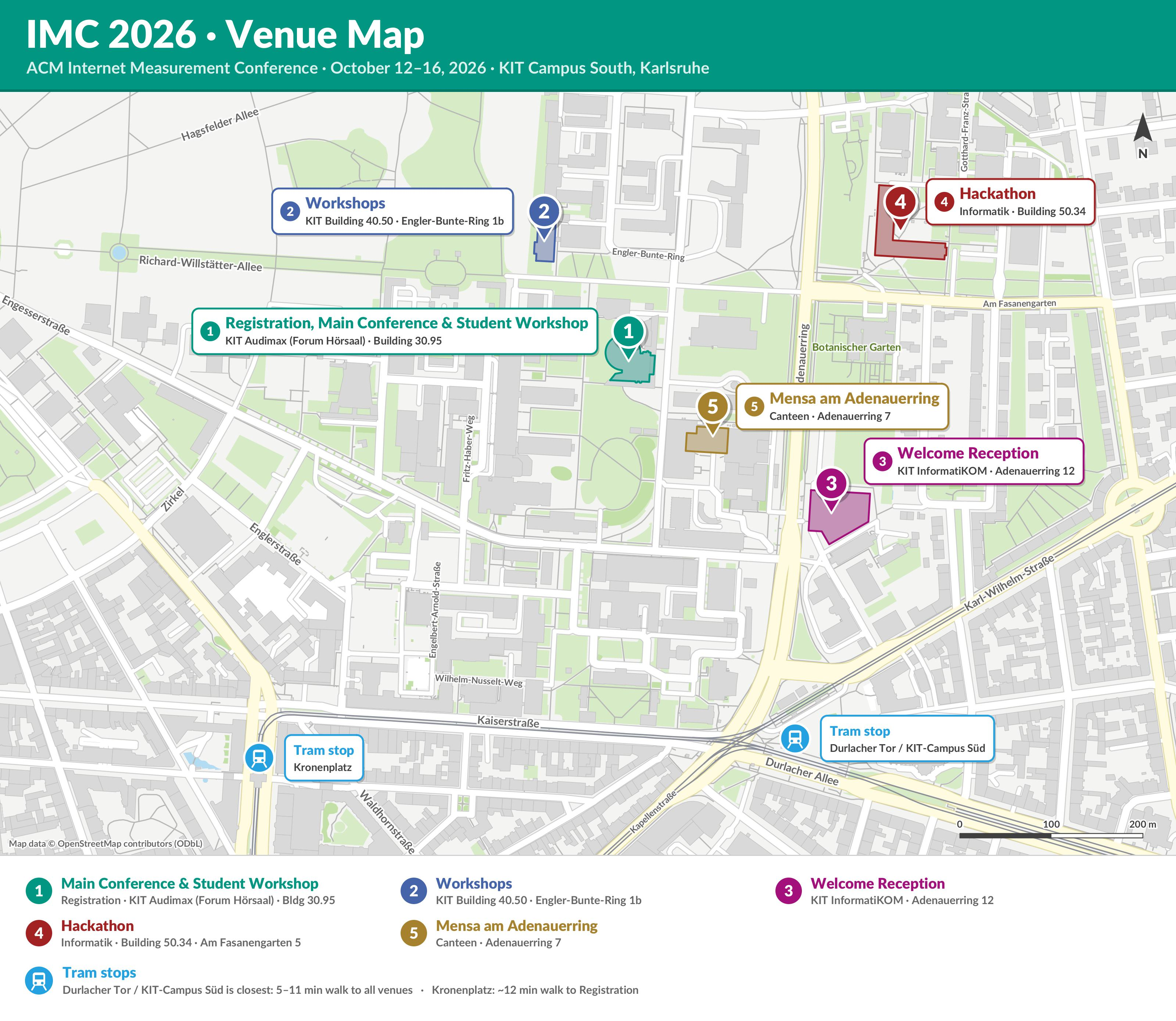
- 1 Registration, Main Conference & Student Workshop – KIT Audimax (Forum Hörsaal), Building 30.95: Straße am Forum 1, 76131 Karlsruhe
- 2 Workshops – KIT Building 40.50: Engler-Bunte-Ring 1b, 76131 Karlsruhe
- 3 Welcome Reception – KIT InformatiKOM: Adenauerring 12, 76131 Karlsruhe
- 4 Hackathon – Informatik, Building 50.34: Am Fasanengarten 5, 76131 Karlsruhe
- 5 Mensa am Adenauerring (Canteen): Adenauerring 7, 76131 Karlsruhe
- Tram Stop 1: Durlacher Tor / KIT-Campus Süd: 5–11 min. walk from all venues (closest stop)
- Tram Stop 2: Kronenplatz: ~12 min. walk from Registration (KIT Audimax, Straße am Forum 1)
Call for Submissions
Following the success of last year’s edition, the main conference will once again be accompanied by a one-day Student Workshop. The ACM IMC 2026 Student Workshop provides an interactive platform for graduate students to engage with one another, learn from senior members of the community, and explore opportunities for collaboration.
The workshop distinguishes itself from the poster session in several ways. First, it features a range of activities, such as panels and keynotes, through which senior members of the community can share guidance, insights, and practical advice. Second, it provides students with a unique opportunity to present their work, for example through lightning talks, and receive constructive feedback from the community. More broadly, the workshop offers a valuable opportunity to further integrate junior researchers into the Internet measurement community and foster their continued engagement with it.
We encourage submissions from graduate students about research at an early stage as well as more advanced dissertation-level research. Research addressing nonstandard topics, controversial problems and approaches are of particular interest.
The scope of the workshop is broad and covers all aspects of networking research with an emphasis on the topics the main conference focuses on. Below are example topics taken from the main conference website:
collection and analysis of data that yield new insights about network structure and network performance (e.g., traffic, topology, routing, energy utilization, performance)
collection and analysis of data that yield new insights about application and end-user behavior (e.g., economics, privacy, security, application interaction with protocols)
measurement-based modeling (e.g., workloads, scaling behavior, assessment of performance bottlenecks, causality)
methods and tools to monitor and visualize network-based phenomena
systems and algorithms that build on measurement-based findings
theoretical analysis and modeling of networked-systems and measurement techniques
novel methods for data collection, analysis, and storage (e.g., anonymization, querying, sharing)
reappraisal of previous empirical network measurements and measurement-based conclusions
descriptions of challenges and future directions the measurement community should pursue
Submission Formats
Please guidelines regarding anonymity, ethics, use of generative AI, and paper formatting—please see the main conference’s Detailed Submission Instructions page with the following added requirement:
Submissions are limited to two pages. Note that the two-page limit includes ALL figures, tables, and references.
The review process is double blind and therefore submissions must be anonymous (i.e. no authors or affiliations should be mentioned in the PDF). Please see the main track CFP for further details on double blind preparation. When registering the paper, the student should be the first author and it can be followed by one or more advisers.
Submit your paper at: https://imc26-studentws.hotcrp.com/u/0/
Important Dates
| Paper submission deadline | August 27, 2026 (AoE) |
| Notification deadline | August 31, 2026 (AoE) |
| Conference and Workshop early registration deadline | September 2, 2026 |
| Workshop date | October 12, 2026 |
Workshop Program
| 9:00-9:55 |
Opening Remarks and Keynote Talk
Keynote Speaker: Oliver Hohlfeld Abstract: New PhD students often believe that good research speaks for itself: do solid work, write it up, and acceptance will follow. This talk argues that this view is dangerously incomplete. Good work can still be rejected if it is poorly written, and even excellent, well-written work can fail if the problem was chosen before the community was ready for it. Drawing on the real history of several of my own papers, I walk through what actually happens on the path from a research idea to a published paper: how problems are chosen, how reviewers read, and how writing itself becomes part of the science. Bio: Oliver is a professor at the University of Kassel in Germany. Prior to this appointment, he held a professorship at the Brandenburg University of Technology (BTU), and he worked at RWTH Aachen University, TU Berlin, and the Deutsche Telekom Laboratories. His academic journey also took him to the United States as a visiting scholar at the University of Wisconsin-Madison. In his research, he views the Internet as the largest distributed system ever built by humans and uses Internet measurements to study it. He has combined psychological approaches with measurements to study aspects of human perception. His work has received awards such as the IETF/IRTF Applied Networking Research Prize, IMC Community Contribution Award, and ACM SIGCOMM Best of CCR (2021 and 2026). He also frequently serves on the TPC of IMC, reviewing a ton of IMC submissions that lead to views reflected in the talk. |
| 9:55-10:30 | Session #1: Networked Systems and Web Technologies |
|
L4S Congestion Control Under Dynamic Workloads Danesh Zeynali [Max Planck Institute for Informatics], Balakrishnan Chandrasekaran [Vrije Universiteit Amsterdam], Anja Feldmann [Max Planck Institute for Informatics] |
|
|
TinyShield: A Browser Extension for Real-time Detection and Blocking of AI-generated videos Ingunn Flovig [Hasso Plattner Institute, Potsdam, Germany], Sonal Khosla [Hasso Plattner Institute, Potsdam, Germany], Vaibhav Bajpai [Hasso Plattner Institute, Potsdam, Germany] |
|
|
Decoupling Lighthouse Gathering and Auditing to Increase Web Crawl Throughput Adrian Kunz [University of Kassel], Lukas Kawollek [University of Kassel], Simon Löser [University of Kassel], Oliver Hohlfeld [University of Kassel] |
|
| 10:30-11:00 | Coffee Break |
| 11:00-12:30 | Session #2: Internet Measurement, Infrastructure, and Network Analysis |
|
Private, Reserved, Visible: Bogon IPs in DNS Fariba Osali [Max Planck Institute for Informatics], Iman Alipour [Max Planck Institute for Informatics], Carlos Gañán [Delft University of Technology], Anja Feldmann [Max Planck Institute for Informatics], Tobias Fiebig [TU Wien] |
|
|
DoH Bench: Measuring Public DoH Resolvers from the User’s Browser Jhannes Reimann [Hasso Plattner Institute / University of Potsdam, Germany], Robert Richter [Hasso Plattner Institute / University of Potsdam, Germany], Vaibhav Bajpai [Hasso Plattner Institute] |
|
|
The Observer Effect in Internet Measurement Abbas Mohsenpour [UCLouvain], Cristel Pelsser [UCLouvain] |
|
|
Picture Please: Diving into Naive Bots Behavior Rémi Van Boxem [UCLouvain], Tom Barbette [UCLouvain], Cristel Pelsser [UCLouvain], Ramin Sadre [UCLouvain] |
|
|
RADAR: Interactive Exploration of 27 Billion PSKReporter Amateur Radio Reception Reports Till Guthardt [University of Kassel], Yasin Alhamwy [University of Kassel], Oliver Hohlfeld [University of Kassel] |
|
|
Expanding RPKI Timing Measurements to In-the-Wild Prefixes Alexander Männel [TU Dresden], Ties de Kock [RIPE NCC], Thomas C. Schmidt [Hamburg University of Applied Sciences], Matthias Wählisch [TU Dresden] |
|
|
Structural Analysis of Network Telescope Data Using Contrastive Learning and Correlation Clustering Jannik Presberger [TU Dresden], Alexander Männel [TU Dresden], Maynard Koch [TU Dresden], Thomas C. Schmidt [Hamburg University of Applied Sciences], Matthias Wählisch [TU Dresden], Bjoern Andres [TU Dresden] |
For any further questions or concerns, please contact the Student Workshop TPC chairs:
Cristel Pelsser (UCLouvain, cristel.pelsser@uclouvain.be)
Ronaldo A. Ferreira (UFMS, raf@facom.ufms.br)